Classic car fair: Highlights of the Klassikwelt Bodensee 2023

Classic aircraft, boats or vehicles - the Classic World of Lake Constance is reminiscent of days gone by. Classic car fans in particular got their money's worth again this year.
It is probably the special mixture that attracts thousands of visitors to the Klassikwelt Bodensee every year. Whether on land, on water or in the air – all interests are served here. This year, the event invited to Friedrichshafen on Lake Constance from May 5 to 7, 2023 and welcomed a total of over 37,000 visitors.
- 12 exhibition halls
- Over 500 exhibitors, clubs and participants
- Oldtimers and Youngtimers
- Porsche, Benz and Corvette anniversaries
- Vintage Racing
- Airshow
During a tour, the carwow editorial team discovered numerous highlights – from an automotive point of view, of course.
959 – the Über-Porsche
Anyone who entered the Klassikwelt Bodensee was greeted by numerous Porsche models in the foyer. The reason: the brand's 75th birthday. A Porsche 959 was not to be missed: In view of the restrained look, it is hard to believe that the super sports car was considered the fastest production vehicle in the world in 1986.
At that time, 450 hp were enough for a Vmax of 317 km/h. A real statement at the time. At that time, the Porsche was also able to keep up with real greats à la Ferrari F40 or Lamborghini Countach.

8x Chevrolet Corvette
In addition to the Porsche brand, the Chevrolet Corvette also celebrated an anniversary at the Klassikwelt Bodensee. Because 70 years ago, in 1953, the first units rolled off the production line. While the first generation C1 (pictured) was still more of a cruiser, the model has developed more and more into a sports car over the decades.
The current eighth generation represents a break: For the first time, the Corvette is designed as a mid-engine sports car. This means that the long, characteristic bonnet is history. On the other hand, the C8 is to clearly distinguish itself from its predecessor versions in terms of driving dynamics.

Sought-after strawberry basket
While such a first-generation VW Golf Cabriolet was still on every street corner in the 1980s, the model has now become rare ... and coveted. Hardly anything goes below 10,000 euros. So there is a loyal fan base for the strawberry basket, which got its nickname because of the conspicuous roll bar. The open-top version of the first Golf is now a regular guest at classic car events and fairs.
The convertible in the picture is from 1990 and produces a manageable 98 hp, even if the paint in Race Blue Metallic somehow promises more. The special thing: the trailer, which was also once a Golf Cabriolet. You don't see such a team every day.

The somewhat different visitor parking lot
A highlight of the Klassikwelt Bodensee is the Parkarena between the halls - here visitors to the fair can park their vehicle with H license plates. "See and be seen" is the motto. And so a demilitarized Humvee was parked here. The civilian version Hummer H1, which already promises a big appearance, was probably not conspicuous enough for the former.
The Willys MB, on the other hand, looks almost dainty to the right. Developed for the 2nd World War, it was called "Jeep" by the soldiers for short. The rest is history.

Lambo at a "special price"
Lamborghini Countach: The Italian adorned the walls of many children's rooms in the 80s or stood in the display case as a 1:18 model. All the nicer when the dream car of childhood is then offered at a "special fair price". In this case, this still meant 575,000 euros. In other words, keep dreaming!
Only 83 examples of the Countach LP 5000 S (from 1982) on display rolled off the production line. A 12-cylinder engine unleashes 374 hp, which is good for a top speed of 290 km/h. Funny side note: The seller pointed out the rarely installed sound system in the data sheet. In view of the sports exhaust system in the rear, however, one wonders why the Italian super sports car needs a sound system. The 12-cylinder is rock concert enough ...

Open tailgate as a distinguishing feature
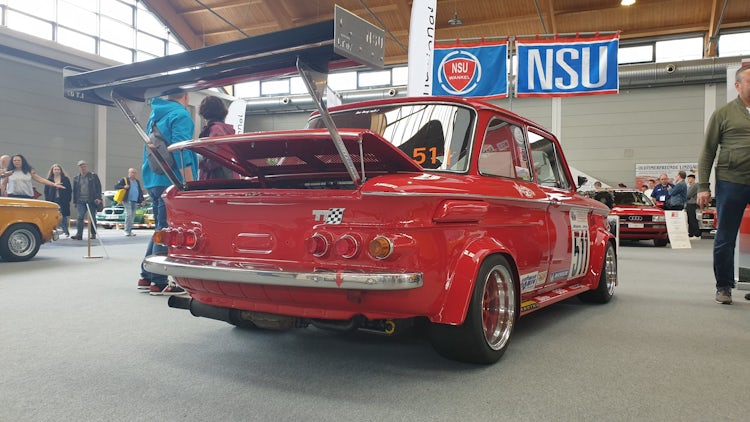
Small car, angular shape, open tailgate? – In most cases, it is then an NSU TT or TTS. The reason for the unusual look is simple: It is intended to improve the cooling of the rear engine.
In the picture you can see a very special TT. And not only because of the generously dimensioned rear spoiler. The rear-wheel drive vehicle belongs to the Hill Climb Cup racing driver Manfred Steinwand. In addition to a number of modifications, whether carbon side fairings or limited-slip differentials, the engine output has been increased from a tame 65 to a potent 116 hp – with a weight well under one ton. Sounds promising.
Legend in innocent white
For the layman, it is not necessarily obvious at first glance, but here is an icon. When Audi launched the "Quattro" all-wheel drive system in the 1980s, it needed a homologation model for the Group B rally cars: the Audi Sport Quattro was born. Today, such a model (only 214 built) is worth several hundred thousand euros in good condition.
Just as legendary as the drive was the five-cylinder engine typical of Audi. Together with a turbocharger, the engine produced an impressive 306 hp at a top speed of 250 km/h. Good to know: Because of its shortened wheelbase, the Sport Quattro is also often called "the short one".

Big is beautiful
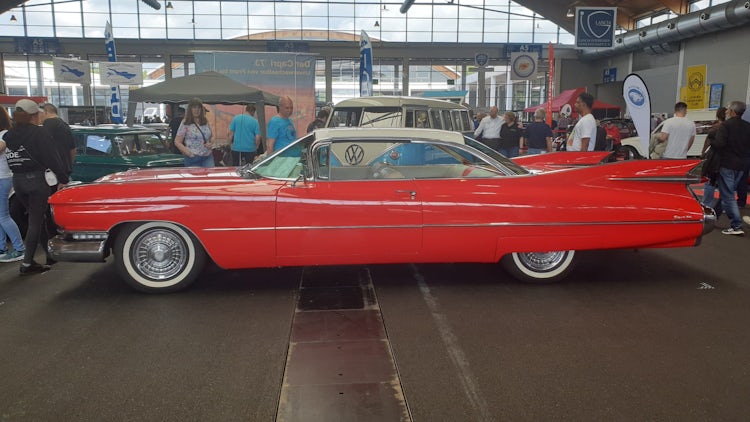
Whether you like US classics or not - such a road cruiser like the Cadillac Coupe de Ville captivates everyone. This is due to the stately size of 5.80 meters and the famous tail fins.
The consumption of the V8 with 325 SAE hp? According to the owner, 18 liters/100 km outside built-up areas and 25 liters in built-up areas ... "with very restrained play with the accelerator pedal" was still written there.
A "sleeper" in its purest form
The Klassikwelt Bodensee thrives on the fact that visitors not only experience vehicles at a standstill, but also in action. In vintage racing, a number of racing classics race around the 1.6-kilometre-long trade fair circuit. If you want, you can take a close look at the highly-bred bolides in the paddock.
When stationary, the Opel Commodore C Caravan from Irmscher (picture) would hardly have been noticed. But as soon as the engine was started, it was clear that there was no standard in-line six-cylinder engine slumbering under the bonnet. This Commodore is powered by a V8 with so much power and torque that driver Jochen Reich covered half of the circuit in a drift. Inconspicuous looks, performance in abundance: The Opel station wagon was a real "sleeper" and the secret star of vintage racing.

French elegance
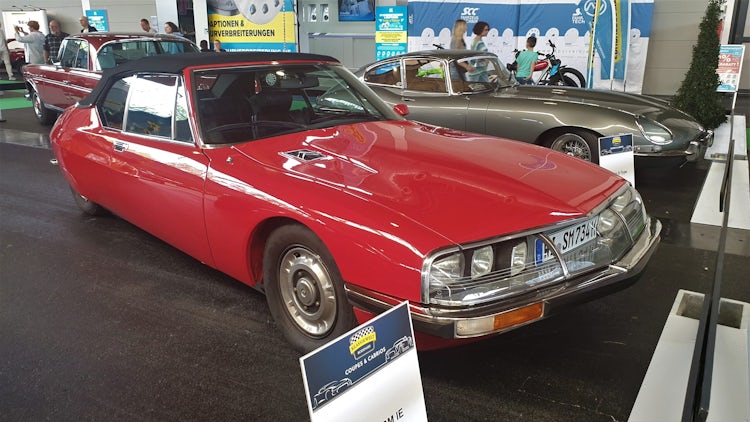
A French model, which was seen conspicuously often at this year's Klassikwelt Bodensee, goes by the name Citroën SM. Built between 1970 and 1975, it is a luxury sports coupé. Typical for Citroën: the closed wheel arches on the rear axle.
The example in the picture is a little out of line, because a convertible was not officially available from the factory. Reason enough for coachbuilders at the time to design an open version themselves. The Citroën SM IE shown here was built by the Wassman company and is one of only three examples built.
A German in Mexico
Such a third-generation Mercedes-Benz SL, better known as the "Pagoda", is usually a filigree automotive work of art. Prices for the W 113 series quickly reached the six-figure range.
To look particularly pretty was not the goal of this "Panamericana Pagoda". To take part in the legendary Carrera Panamericana Rally in Mexico, the 230 SL from 1964 was equipped with an FIA safety cell, Sparco racing bucket seats and fog lights at the front, among other things. We think: Even a Pagoda in racing trim has its charm.

Oldies of the skies
What would a classic car fair in Friedrichshafen be without airplanes? After all, the city on Lake Constance is a part of German aviation history. The nearby Zeppelin and the Dornier Museum also bear witness to this.
At an airshow, the numerous visitors enjoyed impressive flight demonstrations, and there were also some aircraft to marvel at in the exhibition halls. For example, the F4U-4 "CORSAIR" model from 1945. Designed for aircraft carriers, the former fighter aircraft can fold its wings upwards by means of sophisticated hydraulics.
